This session assumes some basic knowledge about what a tracheostomy and a laryngectomy involves and why communication and swallowing is such a problem for patients.
We recommend completing the session Understanding Tracheostomies and Laryngectomies (723-0001) in this series first.
There are important differences between the terms tracheotomy, tracheostomy and laryngectomy. Fatal errors have occurred because healthcare staff do not understand the resulting differences in the anatomy and physiology:
- Tracheotomy
- Tracheostomy
- Laryngectomy
- Neck-only breathers
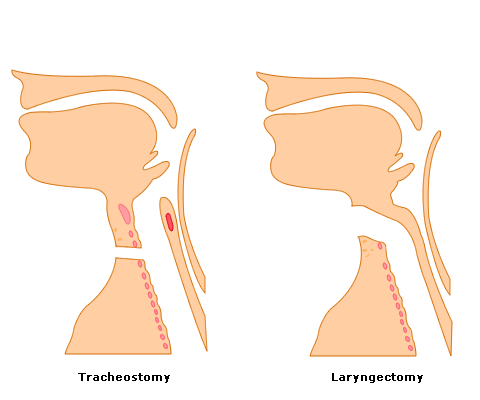
- Fig 1 illustrates the difference between a tracheostomy and a laryngectomy
Tracheotomy is an incision in the trachea and comes from two Greek words: the root tom- meaning 'to cut', and the word trachea.
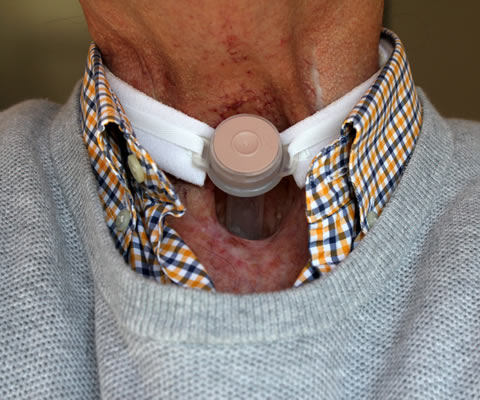
Tracheostomy, including the root stom- meaning 'mouth' - refers to the making of a semi-permanent or permanent opening, and to the opening itself.
There is still an anatomical connection to the upper airways, so the patient has an effective additional airway: the tracheostomy and the existing upper airways (nose and mouth). However, the upper airway may be compromised and should be viewed as a potentially patent. This means that whilst there may be an anatomical connection, upper airway trauma, swelling or cancer can mean that ventilation is difficult or impossible via the upper airways. This can be a temporary or permanent situation.
Laryngectomy is the surgical removal of the larynx, usually completely and permanently. The trachea is mobilised and detached from the upper airways, then the open end is stitched to the front of the neck. As a result, there is no connection from the nose or mouth to the lungs.
Airway management using the upper airways (facemasks, supraglottic airway devices or oral/nasal intubation) will not work. The only airway that the patient has is on the front of the neck.
Neck-only breathers
There can be confusion around which airway a patient is breathing through, as the upper airways, tracheostomy or both airways may be patent (open) and useable. The term neck-only breather should be used for patients who can only breathe through their neck, typically following total laryngectomy or when a tracheostomy has been used to bypass an irreversible obstruction of the upper airway (usually a palliative procedure for cancer).
Some patients with a tracheostomy may still have a potentially patent upper airway. Typically, these patients have had the tracheostomy inserted to manage a non-airway problem (usually to allow long-term ventilation or weaning from ventilation). Whilst the tracheostomy is used as their primary airway (effectively a 'neck-breather'), their upper airways remain potentially patent and could be used. A neck-only breather does not have an upper airway that is connected to the lungs.