Swallowing
Patients with a tracheostomy tube may present with feeding and swallowing difficulties (dysphagia).
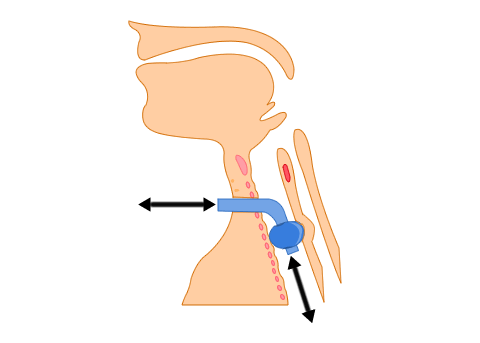
Most paediatric patients will have an uncuffed tracheostomy tube. Cuffed tubes may be used in ventilated patients/patients who are unable to swallow their secretions or older children.
Assessment of the safety of swallowing is necessary as dysphagia can result in aspiration.
Question: What do you think are the signs that may indicate aspiration is occurring?
Patients with a tracheostomy tube may present with feeding and swallowing difficulties (dysphagia).
Most paediatric patients will have an uncuffed tracheostomy tube. Cuffed tubes may be used in ventilated patients/patients who are unable to swallow their secretions or older children.
Assessment of the safety of swallowing is necessary as dysphagia can result in aspiration.
Question: What do you think are the signs that may indicate aspiration is occurring?
Answer: Signs that may indicate aspiration is occurring include:
- Evidence of aspirated material on suctioning from the tracheostomy
- Coughing or choking (although aspiration can also be silent)
- Desaturation during/after feeds
- Increased work of breathing during/after feeds
- Change in voice quality/breath sounds, e.g. sounds 'wet'
- Recurrent chest problems
- Deteriorating chest status
Assessment of feeding and swallowing can be both observational and instrumental.
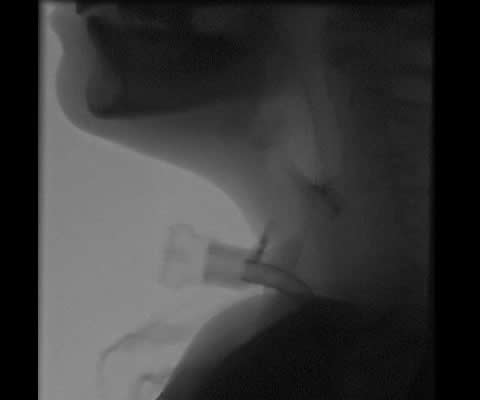
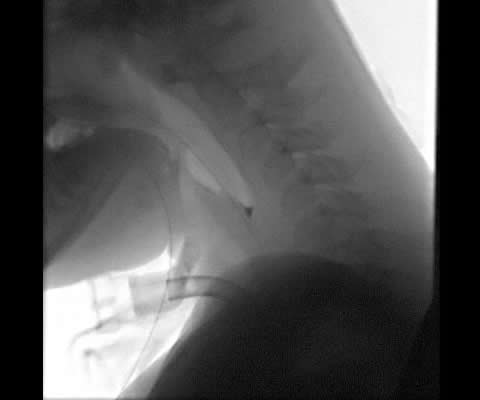
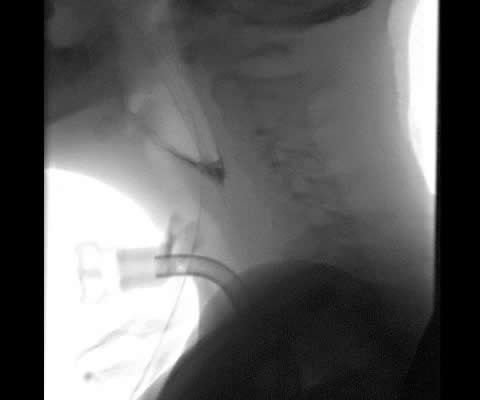
In paediatrics, instrumental assessment is usually performed using Videofluroscopy (VFS). Fig 1 shows different VFS views of a paediatric tracheostomy. Select the numbers to view each image or use the Previous and Next buttons.