Communication
Children may lose their ability to vocalise/cry/babble/speak following a tracheostomy. The Speech/Language Therapist can advise in this situation regarding developing communication skills in other ways. These may include:
- Signing
- Gesture/pointing
- Visual aids, e.g. symbols/photographs/alphabet charts
- Communication aids/communication apps
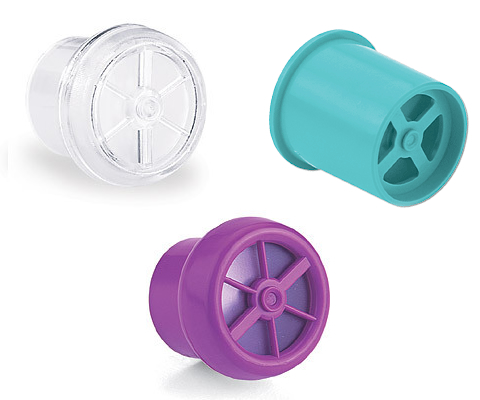
- One-way valve (Fig 1), if sufficient upper airway leak
Question: In what circumstances should a one-way valve not be used?
Children may lose their ability to vocalise/cry/babble/speak following a tracheostomy. The Speech/Language Therapist can advise in this situation regarding developing communication skills in other ways. These may include:
- Signing
- Gesture/pointing
- Visual aids, e.g. symbols/photographs/alphabet charts
- Communication aids/communication apps
- One-way valve (Fig 1), if sufficient upper airway leak
Question: In what circumstances should a one-way valve not be used?
Answer: A one-way valve should not be used in any situation where the airflow cannot escape around the tube or through the upper airway. This includes:
- Upper airway disorders, including obstruction/malacia
- Cuffed tracheostomy tube with cuff inflated
- Uncuffed tube which is tight to shaft, i.e. there is no leak around the tube
- Poor tolerance of valve placement due to behaviour/anxiety
Fig 2 is a short video describing the potential benefits of a speaking valve when used in children with tracheostomies.
Fig 3 is a video demonstrating a typical speaking valve trial in a child.
Children may lose their ability to vocalise/cry/babble/speak following a tracheostomy. The Speech/Language Therapist can advise in this situation regarding developing communication skills in other ways. These may include:
- Signing
- Gesture/pointing
- Visual aids, e.g. symbols/photographs/alphabet charts
- Communication aids/communication apps
- One-way valve (Fig 1), if sufficient upper airway leak
Question: In what circumstances should a one-way valve not be used?
Answer: A one-way valve should not be used in any situation where the airflow cannot escape around the tube or through the upper airway. This includes:
- Upper airway disorders, including obstruction/malacia
- Cuffed tracheostomy tube with cuff inflated
- Uncuffed tube which is tight to shaft, i.e. there is no leak around the tube
- Poor tolerance of valve placement due to behaviour/anxiety
Fig 2 is a short video describing the potential benefits of a speaking valve when used in children with tracheostomies.
Fig 3 is a video demonstrating a typical speaking valve trial in a child.
Children may lose their ability to vocalise/cry/babble/speak following a tracheostomy. The Speech/Language Therapist can advise in this situation regarding developing communication skills in other ways. These may include:
- Signing
- Gesture/pointing
- Visual aids, e.g. symbols/photographs/alphabet charts
- Communication aids/communication apps
- One-way valve (Fig 1), if sufficient upper airway leak
Question: In what circumstances should a one-way valve not be used?
Answer: A one-way valve should not be used in any situation where the airflow cannot escape around the tube or through the upper airway. This includes:
- Upper airway disorders, including obstruction/malacia
- Cuffed tracheostomy tube with cuff inflated
- Uncuffed tube which is tight to shaft, i.e. there is no leak around the tube
- Poor tolerance of valve placement due to behaviour/anxiety
Fig 2 is a short video describing the potential benefits of a speaking valve when used in children with tracheostomies.
Fig 3 is a video demonstrating a typical speaking valve trial in a child.