Equipment Needed
Suction is an important part of tracheostomy care. Often patients cannot cough well due to their underlying condition and they need help. Simply having a tracheostomy interferes with the normal coughing mechanism that involves closing the larynx and allowing pressure to build up to make the cough more forceful. Suction can be used routinely or in an emergency.
The equipment you need for suction includes:
- Appropriately-sized suction catheters
- Suction machine
- Gloves
- Saline and syringes
- Bowl of water (for cleaning tubing)
Suction is an important part of tracheostomy care. Often patients cannot cough well due to their underlying condition and they need help. Simply having a tracheostomy interferes with the normal coughing mechanism that involves closing the larynx and allowing pressure to build up to make the cough more forceful. Suction can be used routinely or in an emergency.
The equipment you need for suction includes:
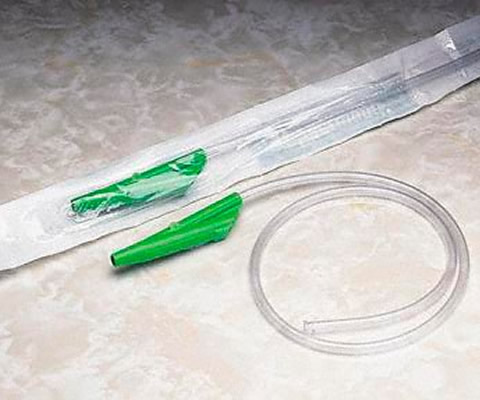
- Appropriately-sized suction catheters (Fig 1)
Suction catheters should be no greater than half the internal diameter of the tube. A new sterile catheter needs to be used for each suctioning procedure.
When suctioning, insert the catheter 0.5 cm past the end of the tracheostomy tube. You can measure this using the spare tube in the emergency box.
- Suction machine
- Gloves
- Saline and syringes
- Bowl of water (for cleaning tubing)
Suction is an important part of tracheostomy care. Often patients cannot cough well due to their underlying condition and they need help. Simply having a tracheostomy interferes with the normal coughing mechanism that involves closing the larynx and allowing pressure to build up to make the cough more forceful. Suction can be used routinely or in an emergency.
The equipment you need for suction includes:
- Appropriately-sized suction catheters
- Suction machine
Check the suction unit at the start of each shift to ensure it is correctly assembled. Make sure the container is changed when full. Rinse tubing after each suction and change tubing if covered in secretions. Check suction pressure, place your thumb over end of suction tubing and adjust according to guidelines (Table 1)
- Gloves
- Saline and syringes
- Bowl of water (for cleaning tubing)
|
Age group |
mmHg | kPa |
|---|---|---|
|
Neonate (0 - 4 weeks) |
60 - 80 | 8 - 10 |
|
Infant (4 weeks - 1 year) |
80 - 100 | 10 - 13 |
|
Child (1 - 11 years) |
100 - 150 | 13 - 20 |
|
Adolsecent (11 years+) |
100 - 200 | 13 - 26.5 |
Table 1 Suction guidelines
Suction is an important part of tracheostomy care. Often patients cannot cough well due to their underlying condition and they need help. Simply having a tracheostomy interferes with the normal coughing mechanism that involves closing the larynx and allowing pressure to build up to make the cough more forceful. Suction can be used routinely or in an emergency.
The equipment you need for suction includes:
Sterile gloves need to be used by all parties in the first week when carrying out suction. Disposable gloves should be used thereafter by nursing staff, unless patient is immuno-compromised/suppressed. Parents do not have to wear gloves but need to ensure strict hand hygiene.
- Saline and syringes
- Bowl of water (for cleaning tubing)

Suction is an important part of tracheostomy care. Often patients cannot cough well due to their underlying condition and they need help. Simply having a tracheostomy interferes with the normal coughing mechanism that involves closing the larynx and allowing pressure to build up to make the cough more forceful. Suction can be used routinely or in an emergency.
The equipment you need for suction includes:
- Appropriately-sized suction catheters
- Suction machine
- Gloves
- Saline and syringes
Saline can be instilled into the tracheostomy tube if secretions are thick. The saline makes the child cough and loosens the secretions. Saline can also be used for nebulisation. Table 2 lists the total volume to be unstilled during each suctioning episode depending on the age of the patient.
- Bowl of water (for cleaning tubing)
|
Age group |
Volume to be instilled (ml) |
|---|---|
|
Neonate (0 - 4 weeks) |
0.5 |
|
Infant (4 weeks - 1 year) |
1 - 2 |
|
Child (1 - 11 years) |
2 |
|
Adolescent (11 years+) |
2 |
Instil slowly
Table 2 Volumes to be instilled