Rescue Breaths and CPR
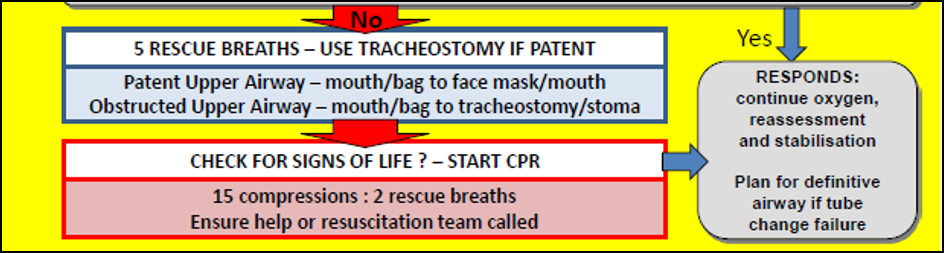
If the patient isn't breathing adequately, give 5 rescue breaths.
You may use the upper airway (mouth/nose) but if this is ineffective you can also use a tracheostomy or direct stoma with a small face mask/LMA.
- Fig 1 is a video showing ventilation via the face
- Fig 2 is a video showing ventilation via the stoma
CPR should be started if the child is not showing signs of life or if heart rate <60.
Continue CPR and make sure the resuscitation team or 999 emergency services are contacted.
If the patient responds to the treatments, continue giving oxygen.
Observe closely and check for any developing problems.
If the patient isn't breathing adequately, give 5 rescue breaths.
You may use the upper airway (mouth/nose) but if this is ineffective you can also use a tracheostomy or direct stoma with a small face mask/LMA.
- Fig 1 is a video showing ventilation via the face
- Fig 2 is a video showing ventilation via the stoma
CPR should be started if the child is not showing signs of life or if heart rate <60.
Continue CPR and make sure the resuscitation team or 999 emergency services are contacted.
If the patient responds to the treatments, continue giving oxygen.
Observe closely and check for any developing problems.
If the patient isn't breathing adequately, give 5 rescue breaths.
You may use the upper airway (mouth/nose) but if this is ineffective you can also use a tracheostomy or direct stoma with a small face mask/LMA.
- Fig 1 is a video showing ventilation via the face
- Fig 2 is a video showing ventilation via the stoma
CPR should be started if the child is not showing signs of life or if heart rate <60.
Continue CPR and make sure the resuscitation team or 999 emergency services are contacted.
If the patient responds to the treatments, continue giving oxygen.
Observe closely and check for any developing problems.