Safety, Stimulate, Shout for Help, Oxygen
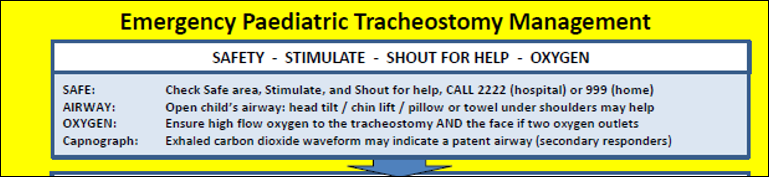
Safety: ensure you are safe to approach. Stimulate the patient by saying 'hello'. Shout for help.
Airway: try to get a position suitable for the child - placing a roll under the shoulders can help to open up the neck and give access to the stoma.
Oxygen: if available, high-flow oxygen should be provided to the face and stoma - this will allow oxygen to get into the lungs if there is any air movement.
Capnograph: a trained secondary responder may be able to put capnography (CO2 monitoring) in line with the tracheostomy to help assess if it is patent.
Detecting of a CO2 waveform is the most reliable way to determine if an airway is patent (clear). Capnography should be immediately available in high care areas and all hospital locations where children with tracheostomies are managed should know how to quickly obtain a capnograph in an emergency.
For more information about capnography see the e-Learning Anaesthesia session Capnography (001-0919).
Fig 1 is a video showing the initial assessment.
Safety: ensure you are safe to approach. Stimulate the patient by saying 'hello'. Shout for help.
Airway: try to get a position suitable for the child - placing a roll under the shoulders can help to open up the neck and give access to the stoma.
Oxygen: if available, high-flow oxygen should be provided to the face and stoma - this will allow oxygen to get in to the lungs if there is any air movement.
Capnograph: a trained secondary responder may be able to put capnography (CO2 monitoring) in line with the tracheostomy to help assess if it is patent.
Detecting of a CO2 waveform is the most reliable way to determine if an airway is patent (clear). Capnography should be immediately available in high care areas and all hospital locations where children with tracheostomies are managed should know how to quickly obtain a capnograph in an emergency.
For more information about capnography see the e-Learning Anaesthesia session Capnography (001-0919).
Fig 1 is a video showing the initial assessment.