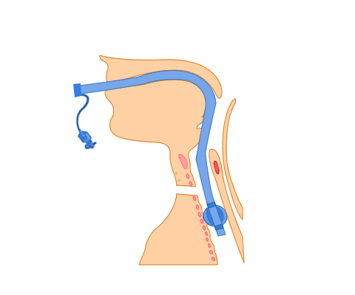
Stoma
This is the preferred route if the child has a non-patent upper airway documented or after failed intubation attempts in a child with a patent upper airway.
Intubation of an established stoma may be relatively straightforward but placing anything blindly into a stoma risks entering a false passage in the anterior tissues of the neck. If there is no alternative, attempting blind insertion of a tracheostomy tube (preferably with the obturator inserted) or bougie may be possible.
Question: Can you think of safer ways to intubate the trachea?

This is the preferred route if the child has a non-patent upper airway documented or after failed intubation attempts in a child with a patent upper airway.
Intubation of an established stoma may be relatively straightforward but placing anything blindly into a stoma risks entering a false passage in the anterior tissues of the neck. If there is no alternative, attempting blind insertion of a tracheostomy tube (preferably with the obturator inserted) or bougie may be possible.
Question: Can you think of safer ways to intubate the trachea?
Answer: A safer way to intubate the trachea would be a fibre-optic guided technique.
Select the Upper airway tab to continue.
Upper airway
Oral intubation may be difficult but should be attempted if the child has a documented patent upper airway or in a child with a non-patent upper airway where intuabtion of the stoma has failed.
Question: What equipment would you need?
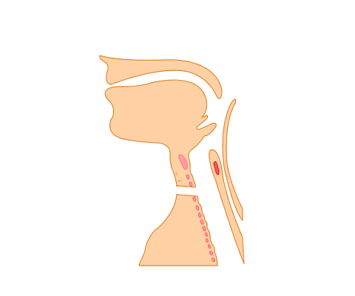
Oral intubation may be difficult but should be attempted if the child has a documented patent upper airway or in a child with a non-patent upper airway where intuabtion of the stoma has failed.
Question: What equipment would you need?
Answer: You would need the following equipment:
- Range of laryngoscopes
- Glidescope ® if available in paeds sizes
- Aintree or airway exchange catheters
- Fibreoptic endoscopes
- Range of endotracheal tubes
- An uncut tube can be advanced beyond the stoma to 'seal' it off (Fig 1). This makes ventilation easier