Overview
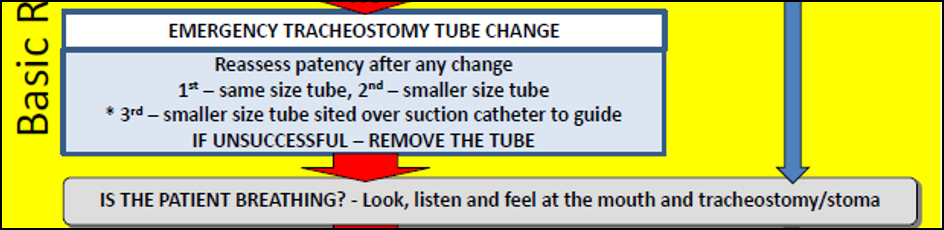
In an emergency, if the tracheostomy is blocked you must remove it.
Once the tracheostomy is removed, you can then replace it with a suitable tube.
In an established tracheostomy, start by attempting to place the same size tube. If this won't pass, then try the size smaller from your emergency TRACHE box.
If unsuccessful, you can try passing the smaller tube in over a suction catheter being used as a guide, and try spreading the skin either side of the stoma.
A blocked tracheostomy is an airway foreign body causing an obstruction and removing this may allow the patient to get some gas flow to temporarily oxygenate their brain.
Fig 1 is a video showing an emergency tube change.
If you can't get a tube in quickly, don't keep trying. Remove the tube and move on to assessing breathing.
Select the Removal of the tube tab to continue.
In an emergency, if the tracheostomy is blocked you must remove it.
Once the tracheostomy is removed, you can then replace it with a suitable tube.
In an established tracheostomy, start by attempting to place the same size tube. If this won't pass, then try the size smaller from your emergency TRACHE box.
If unsuccessful, you can try passing the smaller tube in over a suction catheter being used as a guide, and try spreading the skin either side of the stoma.
A blocked tracheostomy is an airway foreign body causing an obstruction and removing this may allow the patient to get some gas flow to temporarily oxygenate their brain.
Fig 1 is a video showing an emergency tube change.
If you can't get a tube in quickly, don't keep trying. Remove the tube and move on to assessing breathing.
Select the Removal of the tube tab to continue.
Removal of the tube
Removal of a tube (decannulation) is usually an elective procedure, but in the emergency situation, where you have established a tube is blocked or displaced, you must remove the tube as quickly as possible.
The tapes securing the tube are cut and the sutures are removed. The tube is removed and the stoma is covered with a dressing.
After the tube has been removed, you re-assess that patient's airways. You may have relieved tracheal obstruction, and re-established ventilation via the stoma, or via the upper airways.
Ensure oxygen is re-applied to the face and the stoma.
After removal or change of the tube:

Is the patient breathing?
Yes
- Give oxygen
- Reassess
- Stabilise
Is the patient breathing?
No
5 rescue breaths:
- To mouth if patent upper airway
- To stoma if obstructed upper airway